Worksheet guide
What is on the 4 times table worksheet
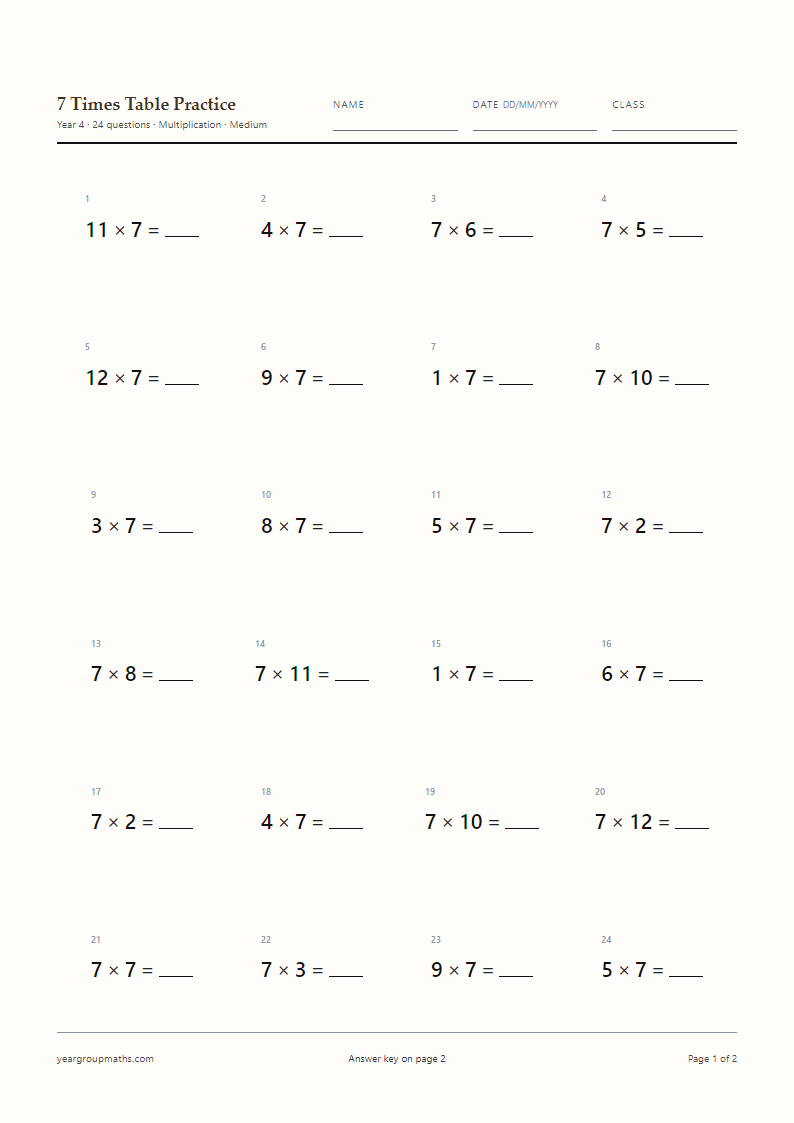
Twenty facts from the 4× table, shuffled, at 18 pt on A4, with the 4× table already selected in the generator. The default Question type is Multiplication; switching to Missing number turns the same twenty facts into 4 × _ = 28 style questions, which is where many children’s understanding of the table actually shows.
Because the sheet is built in the browser, pressing Generate again produces a different set with the same settings. That means one page can be printed as a pre-test and a second, different page as the post-test five minutes later, without storing anything.
Double, double again
Four is two twos, so 4 × 7 is 7 doubled and doubled: 7 → 14 → 28. Teaching the table this way gives children a route to the answer that does not depend on memory, and it explains why every 4× product is even. The same logic carries straight on to the 8× table, which is double the 4× table.
The sheet is a good place to make that link explicit. Ask children to write the matching 2× fact beside three of the questions, for example 4 × 6 = 24 and 2 × 12 = 24. They can see that the same product appears in both tables, which is the beginning of understanding factors.
Pacing it across the week
A common pattern is one 4× sheet on Monday with counters available, one on Wednesday with a two-minute timer, and one on Friday mixed with the 2× and 5× facts. Tick 2×, 4× and 5× together and choose Mixed to build that third sheet quickly.
Keep the marking light. With the answer page beside you, a class set takes a few minutes, and the pattern of errors tells you more than the total score: a child who misses 4 × 7 and 4 × 8 but gets 4 × 2 and 4 × 3 needs the larger multipliers, not the whole table again.
How to use it
How to use this generator
- Check that 4× is the only table ticked.
- Choose Difficulty: Easy for multipliers 1–5, Medium for 2–10, Hard for 2–12.
- Set the question count that fits your slot — 20 is a starter, 24 a lesson task.
- Generate and print; page 2 is the answer key in the same order.
FAQ
Frequently asked questions
What is the quickest way to teach the 4× table?
Double twice. 4 × 8 becomes 8 → 16 → 32. It reuses the 2× table the child already knows and gives them a method rather than a chant.
Can I get a 4× sheet with division too?
Set Question type to Division and the facts reverse: 32 ÷ 4 = _. The divisor stays in the 4× table, so it practises the same family from the other direction.
Why are some 4× products also in the 2× table?
Every multiple of four is also a multiple of two. Children notice this quickly and it is worth naming: it is why 4 × 6 and 2 × 12 give the same answer.
Can two children share one printed page?
No — the sheet is A4 with 20 questions across the full width. Print one per child; the PDF is small and there is no download limit.
Does the sheet work on a tablet?
The generator runs in any modern browser, including on a tablet, but the layout is designed for A4 printing. The browser’s print dialog is what turns it into a PDF.
How do I get a harder version?
Set Difficulty to Hard, which samples multipliers from 2 to 12 and includes the 11× and 12× facts. You can also raise the year, which reduces the type size and fits more questions on the page.
More worksheets