Worksheet guide
What Key Stage 2 covers here
Key Stage 2 is Years 3 to 6. Year 3 starts with three-digit column addition and the 3, 4 and 8 tables. Year 4 works on all tables to 12 × 12 and four-digit column methods. Year 5 brings in the grid method and long division. Year 6 keeps the same methods with five-digit numbers and two-digit divisors.
The written-method pages sit alongside the year pages, because a method is not tied to one year: column addition runs from Year 3 to Year 6, and the same page changes the number of digits when you change the year.
How the Key Stage 2 year bands differ
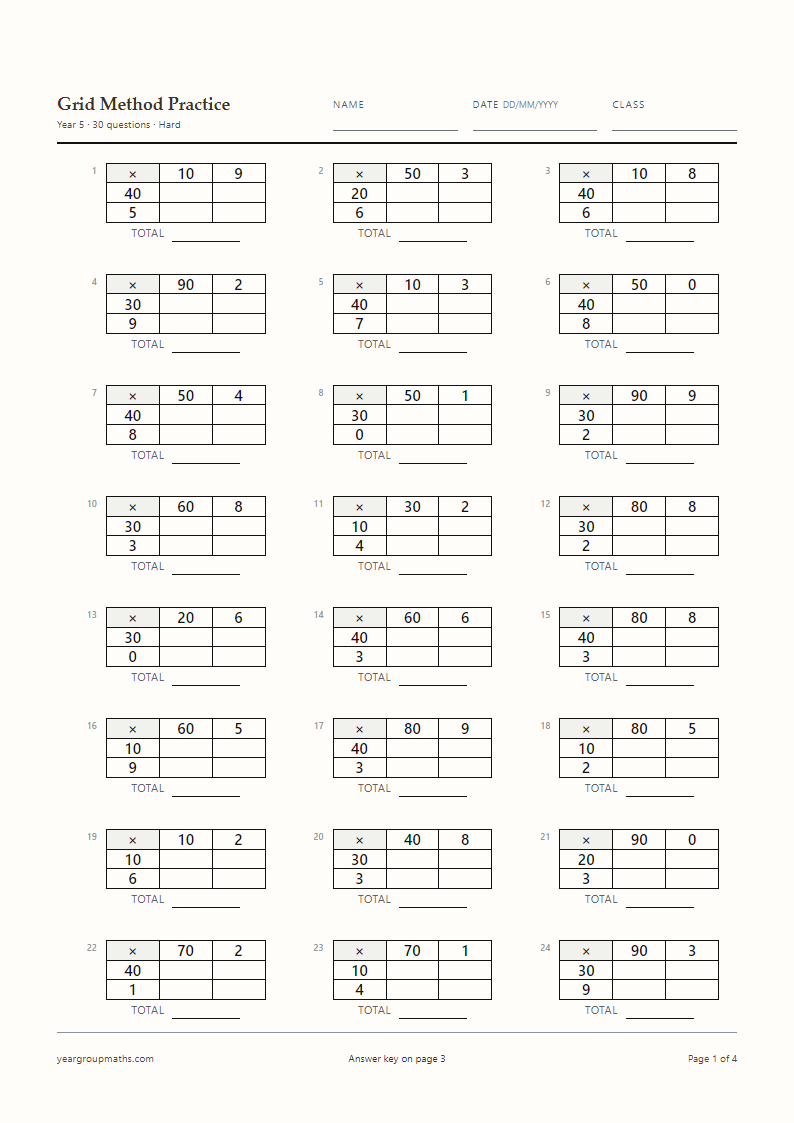
Years 3 and 4 print at 16 pt with twenty-four questions. Years 5 and 6 step down to 14 pt and keep twenty-four, because the grid method and long division need a wider cell and two ruled working lines; thirty questions of either runs onto a second sheet.
Difficulty is a separate control from the year. Choosing Hard on a Year 4 sheet keeps four-digit numbers but adds more carrying, which is usually the right move when a class is ready for a longer sheet rather than different numbers.
Where to start
For a whole class, start on the year page and use the preset it opens with. For a method lesson, start on the method page and set the year to match the group, because the method page keeps the topic fixed while the year changes the digits.
Every page carries the same generator and the same ready-made PDFs, so a sheet found on one page can be reproduced from another without a different set of instructions.
How to use it
How to use this generator
- Pick Year 3, 4, 5 or 6 at the top; the type size and question count follow.
- Choose times tables for recall, or a written method for the lesson focus.
- Set Difficulty to Medium for a first attempt and Hard once the method is secure.
- Generate, then print or download the PDF — page 2 is the answer key.
- Use the year pages to see everything a single year offers.
FAQ
Frequently asked questions
Which years are in Key Stage 2?
Years 3, 4, 5 and 6 in England. Key Stage 1 is Years 1 and 2, collected on the KS1 page.
When do children sit the multiplication tables check?
The check is taken at the end of Year 4. There is a separate practice page that sets all tables to 12 × 12 in mixed order, which is closer to the check than a single-table sheet.
Why do Years 5 and 6 stay on twenty-four questions when the type gets smaller?
Fourteen-point type would hold thirty table facts on a page, but the Year 5 preset opens on the grid method and the Year 6 preset on long division. Both need a wide cell: a 2-digit by 2-digit grid takes a 60 mm column and long division needs two ruled working lines under every frame, so thirty questions would spill onto a second sheet and both years keep twenty-four.
What is the difference between short division and the bus stop method?
They are the same layout. Short division is the name usually used once the method is secure; the bus stop method is the name used when it is first introduced, from the shape of the bracket.
Can I set long division for a Year 3 child?
Long division is not offered below Year 5, because the digit sizes and two-digit divisors it uses are outside that year’s range. If you pick Year 3 on a long-division page, the site switches to a topic that year does offer and says so above the sheet.
Are the sheets aligned to a particular scheme of work?
No. The year labels are a practical guide rather than a statement about any school’s order of teaching, and no page claims to be required or endorsed by anyone.
More worksheets