Worksheet guide
What the multiplication tables check is
The multiplication tables check is the assessment taken by Year 4 pupils in England at the end of the year. It has twenty-five questions. Each question is on screen for six seconds, and there is a three-second gap between one question and the next, so the whole check takes a few minutes and never waits for an answer.
The facts are drawn from every table rather than presented one table at a time. That structure is why this page exists: a child can score full marks on a 7× sheet and still struggle on the check, because the check never tells them which table the next fact comes from. Practice has to include that uncertainty.
On paper, the twenty-five question setting here follows the same shape: five columns of five, on one A4 page. To rehearse the timing, put a phone timer on the desk and give six seconds a question.
How these sheets mirror it
Every sheet on this page draws from all twelve tables in a shuffled order. The All setting weights the twelve tables evenly, so a twenty-five question sheet gives each table two or three facts, in random order.
Question type is locked to multiplication by default, because that is the form the check uses. Nothing tells a child which table is coming next.
A weekly routine that works
Three short sheets a week beats one long one. Print set A on Monday as a cold start, set B on Wednesday, and the speed sheet on Friday with a fixed time limit. Keep the limit the same each week so the comparison means something, and record the time rather than only the score.
Use the answer page to sort errors into two groups: facts the child does not know, and facts they know but missed under time pressure. The first group needs teaching; the second needs exactly this kind of timed practice. The two groups need different responses, and the answer page makes the split quick to do.
What practice cannot do
The check is taken on a screen, and paper practice does not rehearse the on-screen format. What paper practice does rehearse is the retrieval itself, which is the part most children find hard and the part that improves with repetition.
These sheets are independent practice material. They are not past papers, they do not reproduce the check, and they are not produced or endorsed by the Standards and Testing Agency.
How to use it
How to use this generator
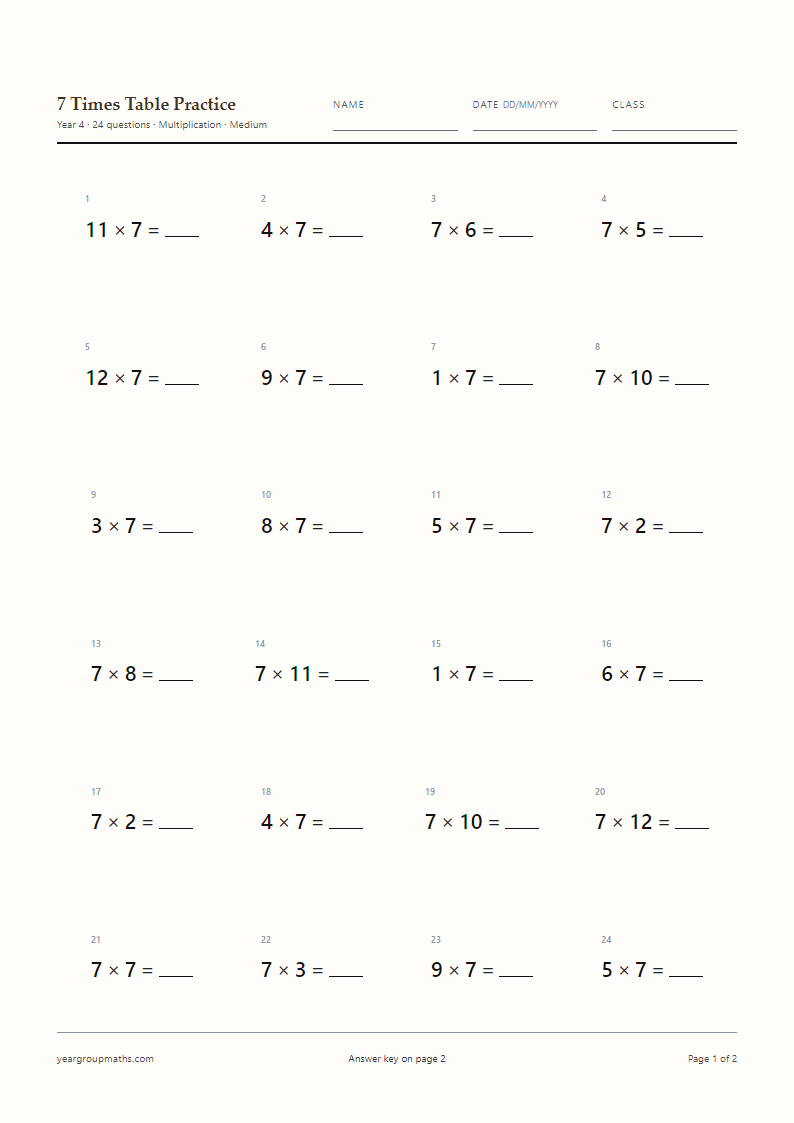
- Leave Year on 4, which sets 16 pt type and 25 questions — five rows of five.
- Set Tables to practise to All for even coverage, or Mixed for a random spread.
- For timing, give six seconds a question and a three-second pause between them, the way the check runs.
- Generate, print, and keep the same time limit each week.
FAQ
Frequently asked questions
What is the multiplication tables check?
It is the times tables assessment taken by Year 4 pupils in England at the end of the year. It covers facts from every table, so mixed practice is the most useful preparation.
How many questions are in the check?
Twenty-five. The sheet on this page defaults to the same number, set as five columns of five on one A4 page.
How long is there for each question?
Six seconds for each answer, with a three-second gap before the next question appears. A paper version cannot enforce that, but a phone timer set to six seconds gives the same pressure.
Which tables does it cover?
The check draws on tables up to 12 × 12. This page ticks all twelve tables by default so the practice matches that range.
Should I practise one table at a time?
Only when a table is being learned. Once several are known, mixed practice is what builds the retrieval the check needs. The single-table pages are there for the learning stage.
Does the order of the facts matter?
Yes. Shuffled order stops a child predicting the next fact from the last one, which is the main difference between reciting a table and knowing it.
Can I use these sheets in Year 3?
Yes. Change Year to 3 and the type size and question count follow that year. Many schools start mixed practice in Year 3 so that Year 4 is consolidation.
Is this a real check paper?
No. It is independent practice material with no connection to the Department for Education or the Standards and Testing Agency.
More worksheets