Worksheet guide
What is on the 12 times table worksheet
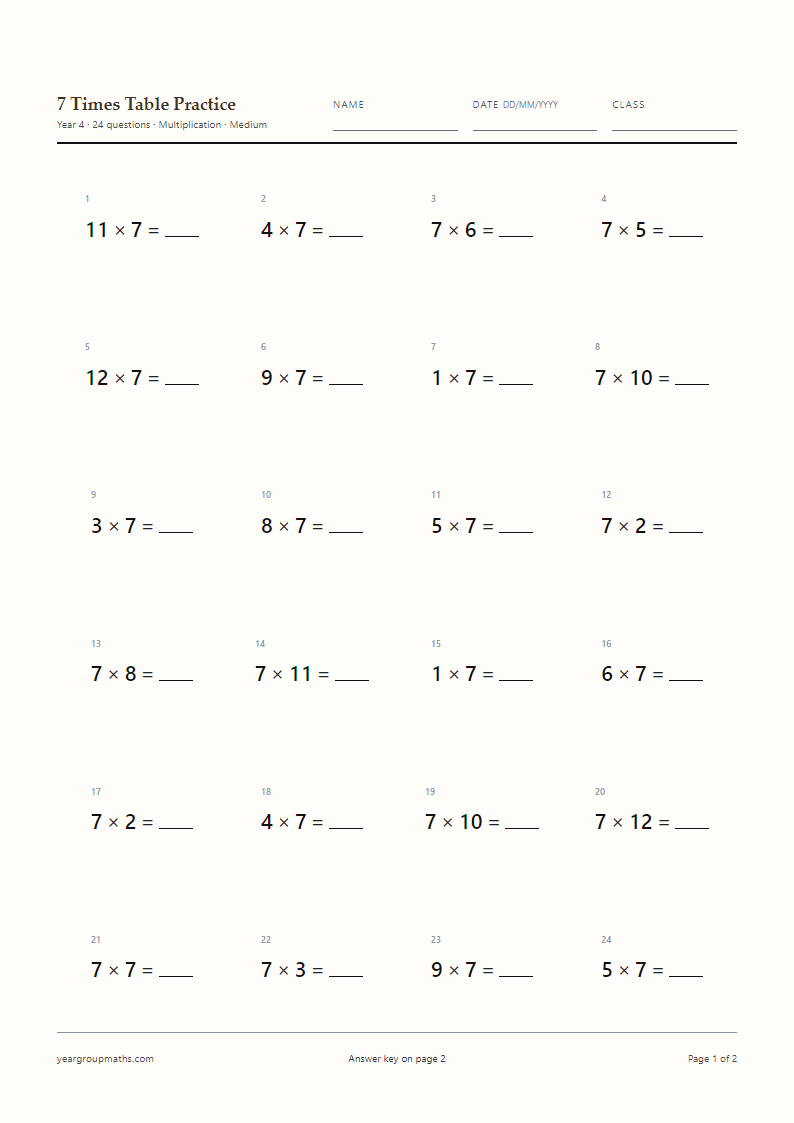
Twenty 12× facts, shuffled, at 18 pt on A4, with 12× preselected and the answer key on page 2. The top of the table — 12 × 11 = 132 and 12 × 12 = 144 — is included rather than avoided, because those are the facts most likely to be missing.
The sheet is set horizontally by default. Switching Layout to Column gives the same facts written as a vertical multiplication, which is useful when children are moving on to formal written multiplication.
Ten plus two
Every 12× fact is a 10× fact plus a 2× fact: 12 × 7 = 70 + 14 = 84. It is the same structure as 11× (ten plus one) and it means the 12× table is not really a new table at all — it is two known tables added together.
Twelve also has real-world anchors worth using: twelve months in a year, twelve in a dozen, twelve hours on a clock face, twelve edges on a cube. A child who can picture 12 × 4 as four dozen eggs has a way in that a bare list of numbers does not give.
The step into written multiplication
Once the 12× table is secure, the natural next move is two-digit by one-digit multiplication, where children partition the two-digit number and multiply each part. The grid method page does exactly that, and it uses the same facts in a different arrangement.
A useful sequence is a 12× sheet on Monday, a grid method sheet on Wednesday using the same table, and a mixed sheet on Friday. The facts stay the same; only the representation changes.
Twelve outside the classroom
Twelve has more everyday anchors than any other table: months in a year, eggs in a dozen, hours on a clock, players in a football team, edges on a cube. Ask a child how many eggs there are in three dozen and they are using 12 × 3, whether or not they name it that way. Naming the connection is what turns a table into a tool.
How to use it
How to use this generator
- Check that 12× is ticked on its own for a focused sheet.
- Use Hard to make sure 12 × 11 and 12 × 12 appear.
- Switch Layout to Column for a vertical version of the same facts.
- Generate and print; page 2 holds the answers.
FAQ
Frequently asked questions
How do I work out 12 × 9 quickly?
Ten nines plus two nines: 90 + 18 = 108. Or twelve nines is twelve tens minus twelve: 120 − 12 = 108. Both take a couple of seconds once the 10× table is secure.
Is 12 × 12 the largest fact on the sheet?
Yes. The generator samples multipliers from 1 to 12, so 144 is the largest product. Nothing above 12 × 12 appears.
Why does the multiplication tables check stop at 12 × 12?
That is the range the check covers. This site follows the same range so that practice sheets match the facts children are expected to recall.
Can I print a 12× sheet in column layout?
Yes. Change Layout to Column and the facts are set out vertically, one number above the other, with space for the answer underneath.
Does the sheet include division facts for 12×?
Set Question type to Division and you get 84 ÷ 12 = _. It is a harder version of the same table and good preparation for short division.
Can I make a 12× sheet with 40 questions?
Yes, but it will print over two pages, with the answer key on the pages after the questions. For a single sheet, 20, 24 or 30 is the practical range.
More worksheets