Worksheet guide
What is on the 11 times table worksheet
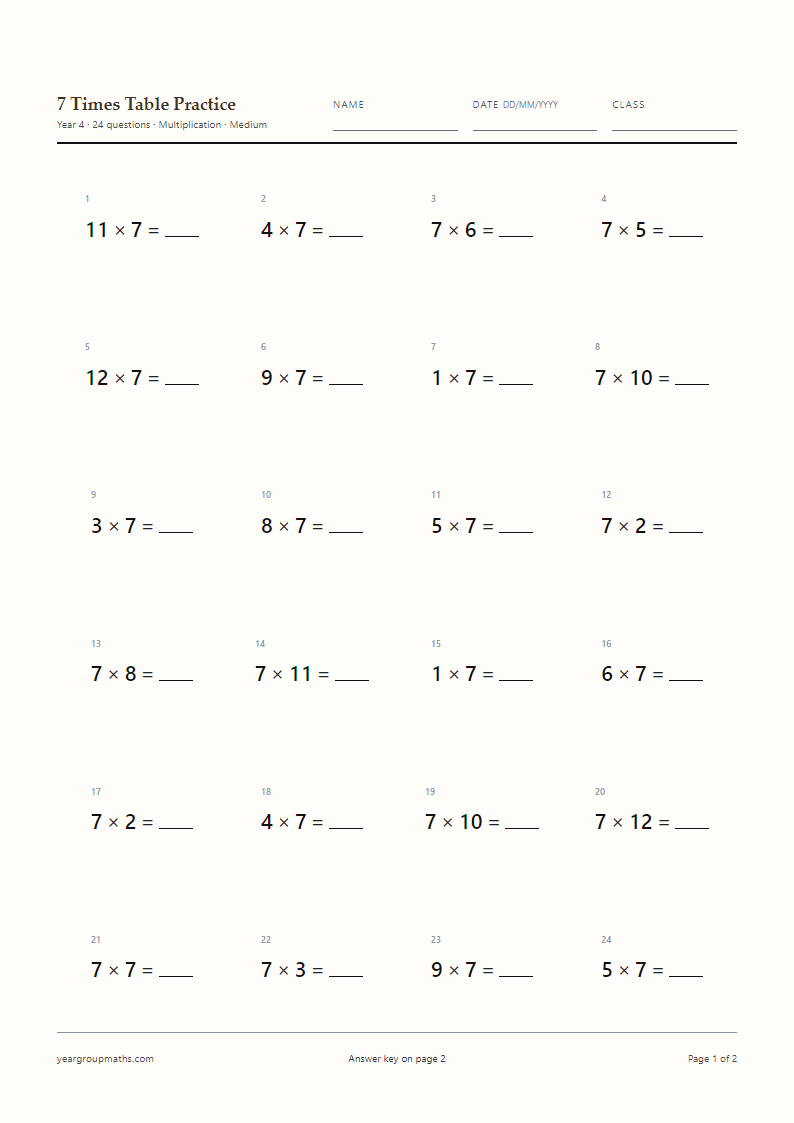
Twenty 11× facts in shuffled order at 18 pt on one A4 page, with 11× already ticked and the answer key on page 2. The default 20 questions includes the higher facts, so children meet 11 × 11 = 121 and 11 × 12 = 132 as well as the easy repeated-digit ones.
Switch to Division and the sheet becomes 132 ÷ 11 = _, which is a much harder task than the multiplication version and a useful next step for a child who has the table secure.
Where the pattern stops
From 11 × 1 to 11 × 9 the answer is simply the multiplier written twice: 11 × 4 = 44, 11 × 7 = 77. Children spot this immediately and often conclude that they know the table. Then 11 × 10 = 110, 11 × 11 = 121 and 11 × 12 = 132 break the pattern, and the confidence disappears.
The reliable method underneath the pattern is 10× plus 1×: 11 × 7 = 70 + 7 = 77, and 11 × 12 = 120 + 12 = 132. That method covers the whole table, which the repeated-digit trick does not. Teaching the trick is fine as long as the method comes first.
A good extension
Ask children to find every 11× fact where the digit sum of the answer is 2 — that is, where the answer is a repeated digit. They will find nine of them, and the remaining three are exactly the ones that need real practice.
Pair this sheet with the 12× page in the same week. Both tables are built on 10× plus something, and seeing the two together makes the structure obvious rather than incidental.
Why eleven is worth the practice
Eleven is at the top of the range and the facts turn up less often in everyday maths, which is exactly why they need deliberate practice. A quick game is to ask for the eleventh multiple of any number and let the child build it from ten times plus one times. It takes ten seconds and keeps the method alive between sheets.
How to use it
How to use this generator
- Confirm 11× is the only table selected.
- Use Hard if you want 11 × 11 and 11 × 12 to appear more often.
- Try Division for a much harder version of the same facts.
- Generate and print; page 2 is the answer key.
FAQ
Frequently asked questions
Why does the repeated-digit pattern stop at 11 × 9?
Because the product reaches three digits at 11 × 10. Below that, the tens and ones are the multiplier; above it, the digits carry into hundreds.
What is the best method for 11×?
Multiply by 10 and add one more group: 11 × 8 = 80 + 8 = 88, 11 × 12 = 120 + 12 = 132. It works for every fact in the table.
Are 11× and 12× part of the tables children are expected to know?
The multiplication tables check covers tables up to 12 × 12, so 11× and 12× facts can appear. This site builds sheets for both; check your own school’s scheme for when each is introduced.
Can I get a sheet with only 11 × 11 and 11 × 12?
Not directly. The Hard setting includes them along with the other multipliers, and the answer page shows which ones a child missed.
Does the answer page use the same order?
Yes. Same grid, same type size, same order, so marking is a straight read across.
Is there a printable 11× poster?
No. This site only produces practice sheets; posters and display materials are outside its scope.
More worksheets