Worksheet guide
What is on the column addition sheet
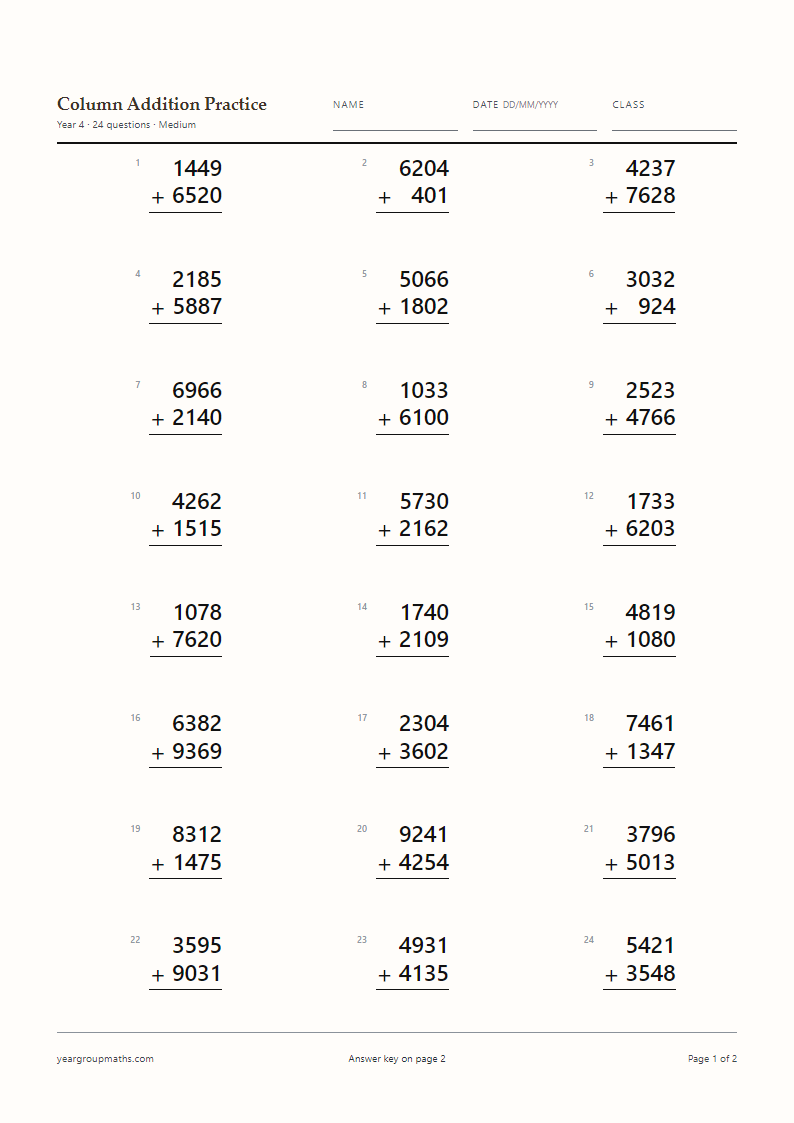
Each question is set out vertically, with one number above the other and a rule under them for the answer. The digits are right-aligned in a fixed width, so hundreds sit under hundreds and thousands under thousands even when the two numbers have different lengths.
Carrying allowed controls what appears. Set to No, every column adds to nine or less, so the child practises alignment and place value without meeting an exchange. Set to Yes, roughly half the questions include at least one carry, which gives a mix rather than a page of nothing but carries.
How column addition works
Start at the ones column on the right. Add the two digits and write the ones digit of the total under the line. If the total is ten or more, carry the ten into the next column and add it with the digits there. Repeat for tens, hundreds and beyond.
The method depends on the digits staying in their columns. A child who writes the answer one place to the left has not made an arithmetic error — they have made a layout error, and the sheet is designed so that is easy to see. The right-aligned digits and the rule under the sum make a shifted answer obvious at a glance.
Errors worth looking for
Three mistakes account for most wrong answers. The first is forgetting to add the carry, which usually produces an answer exactly ten or a hundred out. The second is carrying into the wrong column, often from ones straight to hundreds. The third is adding the digits in the wrong order when the numbers have different lengths, for example aligning 47 under 306 without a placeholder.
Marking from page 2 shows the pattern quickly: if a child’s errors are all in the tens column, the carry is the problem; if they are scattered, the layout is. Either way the fix is a shorter sheet and one worked example on the board before the next attempt, not another twenty questions of the same thing.
How to use it
How to use this generator
- Choose Column addition as the topic — the layout is fixed to Column.
- Set Carrying allowed to No for a first lesson, Yes once the method is secure.
- Use the Year dropdown to set the number of digits and the type size.
- Generate, print, and mark from the answer page.
FAQ
Frequently asked questions
What does carrying mean in column addition?
When a column adds to ten or more, the ten is carried into the next column on the left. In 47 + 38, the ones column makes 15, so 5 is written and 1 ten is carried to the tens column.
Why do some schools say exchanging instead of carrying?
Exchange is the term many calculation policies now use, because the ten ones really are exchanged for one ten. Carrying means the same thing and is still widely used. This site labels it Carrying allowed.
How many digits should the numbers have?
The Year dropdown sets it: Year 3 gives three digits, Year 4 four, Year 6 five. Difficulty shifts it by one step either way.
Can I print addition without carrying?
Yes. Set Carrying allowed to No and every column will add to nine or less, which is the right starting point for a first lesson on the method.
Does the sheet show place-value headings?
No. The columns are aligned but not labelled. That matches how the method is set out in exercise books, where the alignment does the labelling.
Can I get a sheet with three addends?
No, every question has two numbers. Adding three numbers is a separate step and is not one of the layouts on this site.
More worksheets