Worksheet guide
What is on the column subtraction sheet
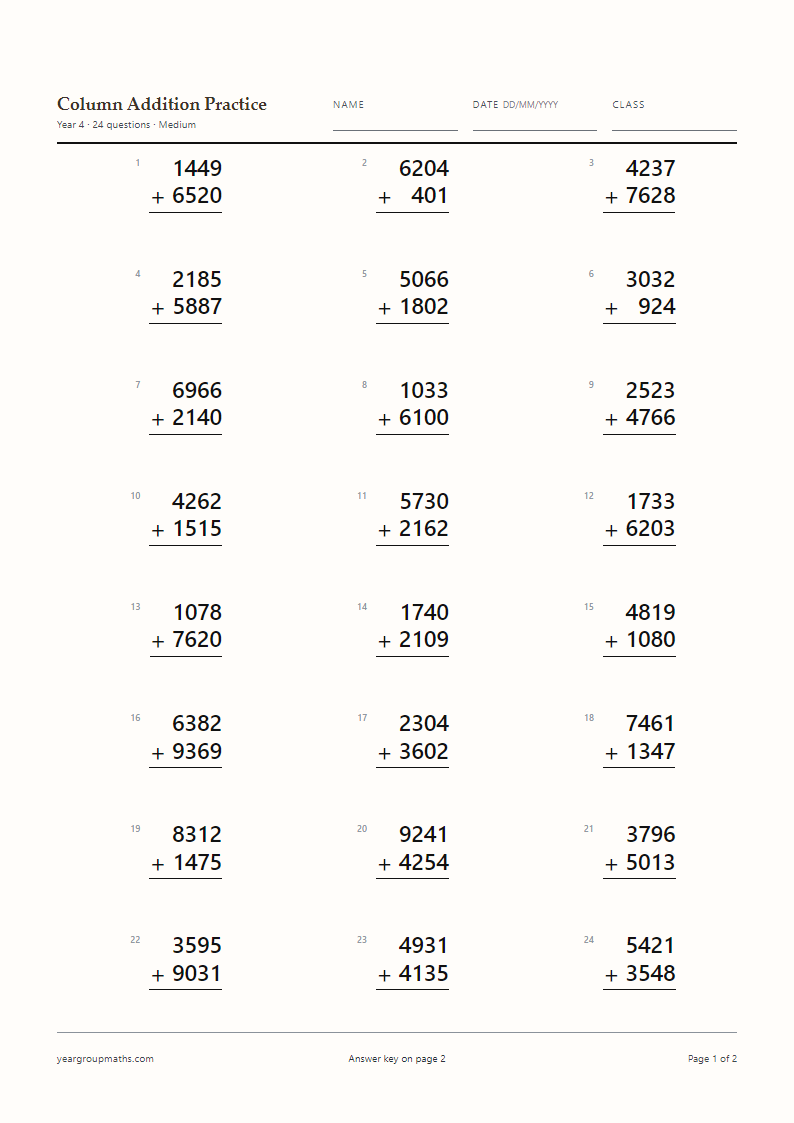
Each question sets the larger number above the smaller one, right-aligned, with a rule underneath for the answer. Borrowing allowed controls whether any column needs an exchange: set to No, every digit on the top row is at least as large as the digit below it, so the subtraction runs straight through.
With borrowing on, about half the questions include at least one exchange. That mix matters, because a sheet where every question needs a borrow teaches a different lesson from one where only some do.
How borrowing works
Start at the ones column. If the top digit is smaller than the bottom digit, take one ten from the next column to the left and add it to the ones digit, making it ten bigger. Subtract, write the answer, then continue. If the next column is a zero, the borrow has to move two columns left, which is the step most children need to see worked slowly.
Some calculation policies call this exchanging rather than borrowing, because one ten is exchanged for ten ones. The arithmetic is identical; only the vocabulary differs, and it is worth using whichever term your school uses so the sheet and the lesson match.
The three common errors
The first is subtracting the smaller digit from the larger regardless of which is on top, so 52 − 37 becomes 25. The second is borrowing but forgetting to reduce the column borrowed from, which puts the answer ten or a hundred out. The third is a borrow across a zero, where the child borrows from a zero without first exchanging down the columns.
A no-borrowing sheet isolates the first error: if a child is fine without borrowing but wrong with it, the layout is secure and the exchange is what needs teaching.
Checking a subtraction by adding back
Every column subtraction can be checked in a few seconds by adding the answer to the number that was taken away. If 304 − 178 = 126, then 126 + 178 should come back to 304. Children who build that habit catch most of their own slips before the sheet is marked, and the column addition page is exactly the practice the check needs.
How to use it
How to use this generator
- Choose Column subtraction; the layout is fixed to Column.
- Set Borrowing allowed to No for a first sheet, Yes once the exchange is understood.
- Pick the year to set the number of digits and the type size.
- Generate, print, and mark from page 2.
FAQ
Frequently asked questions
What is borrowing in column subtraction?
When the top digit is smaller than the bottom digit, one ten is taken from the column to the left and added to the top digit, making it ten larger so the subtraction can go ahead.
Is it borrowing or exchanging?
Both terms describe the same move. Many schools now say exchanging because one ten becomes ten ones. This site uses Borrowing allowed, which is the wording most parents search for.
How do I teach borrowing across a zero?
Work one example slowly: 304 − 178. The ones column needs a borrow, but the tens column is empty, so the hundred is exchanged for ten tens, and one of those tens is exchanged for ten ones. Printing a borrowing sheet after that example gives the practice.
Why is the larger number always on top?
Because the topic is column subtraction with positive answers. Questions are generated so the answer is never negative and never zero.
Can I get a sheet where no borrowing is needed?
Yes. Set Borrowing allowed to No. Every digit on the top row will then be at least as large as the digit below it.
Does the sheet include decimals?
No. Every question uses whole numbers, which keeps the column alignment unambiguous.
More worksheets