Worksheet guide
What the Year 5 preset does
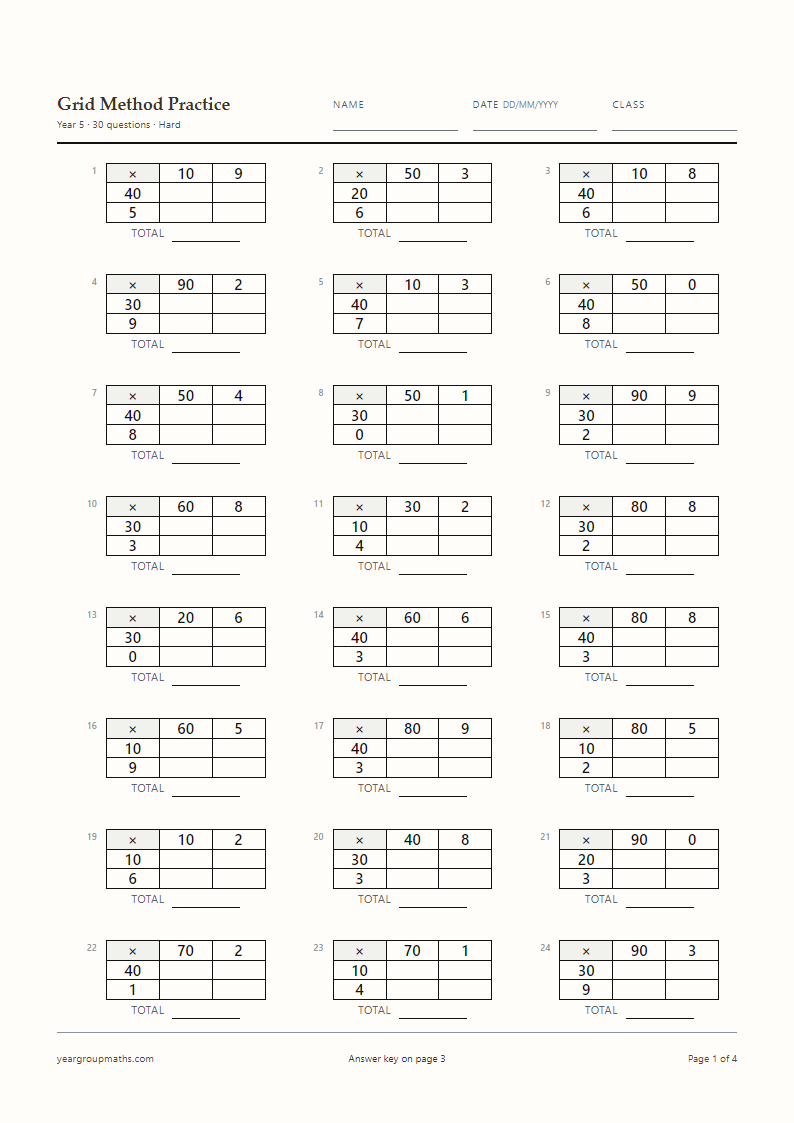
Year 5 sets 14 pt type. This page opens on 24 questions because each grid needs a wide cell: a 2-digit by 2-digit grid only fits a 60 mm column. Switch to column work and 30 questions still fits one page.
Vertical layouts still get one extra step, so a Year 5 long division sheet is printed at 16 pt. That is the size at which the divisor, the digits and the working lines stay legible at arm’s length.
Grid method multiplication
The grid method splits both numbers into tens and ones and multiplies every pair, then adds the parts. The sheet prints the grid with the parts already labelled, for example 30 and 4 across the top and 20 and 6 down the side, and leaves the four cells and the total for the child.
It is a bridge rather than a destination: children who can complete a grid reliably find the compact written method much easier, because they have already seen where each partial product comes from.
Long division
Long division with two-digit divisors is the hardest written method in primary maths, and it needs space more than it needs speed. The long division layout prints the bus stop frame with two ruled working lines underneath, which is enough for a three- or four-digit dividend divided by a two-digit divisor.
Keep the sheet short. Twenty-four long division questions is a full lesson of work; a longer sheet is only sensible for a fluent class, and the layout will shrink to fit.
Marking written methods quickly
Long division and grid method answers are easy enough to mark from page 2, but the useful information is in the working. Collect a few sheets and look for the pattern: a product written in the wrong column, a partial product missing, a subtraction step that slipped. The answer page tells you who is wrong; the working tells you why, and that is what decides what you teach next.
How to use it
How to use this generator
- Leave Year on 5 for 14 pt type and 24 questions.
- Choose Grid method multiplication for 2-digit by 2-digit work.
- Choose Long division for two-digit divisors; 24 questions fits the frame better than 30.
- Print page 1 and mark from page 2.
FAQ
Frequently asked questions
What is the grid method?
A way of multiplying that splits each number into tens and ones, multiplies every pair of parts and adds the results. It makes the partial products visible before the compact written method is introduced.
Should Year 5 use grid method or long multiplication?
Most classes use the grid method to secure understanding, then move to the compact method. This site builds the grid method; the compact method is not one of its layouts.
How many long division questions should I print?
Twenty-four fits the frame on one page at 16 pt. A longer sheet is available from the Questions selector, but the cells get shorter, so the working lines are tighter.
Can I print long division with remainders?
Yes. Set Division gives whole numbers to No and some answers will include a remainder.
What is the difference between short and long division?
Short division keeps the working in your head and writes only the quotient above the digits. Long division writes the subtraction steps down, which is why it needs more space.
Are the answers on a separate page?
Yes, always page 2 by default. The answer page uses the same grid and the same order, so marking is a straight read across.
More worksheets