Worksheet guide
What is on the 3 times table worksheet
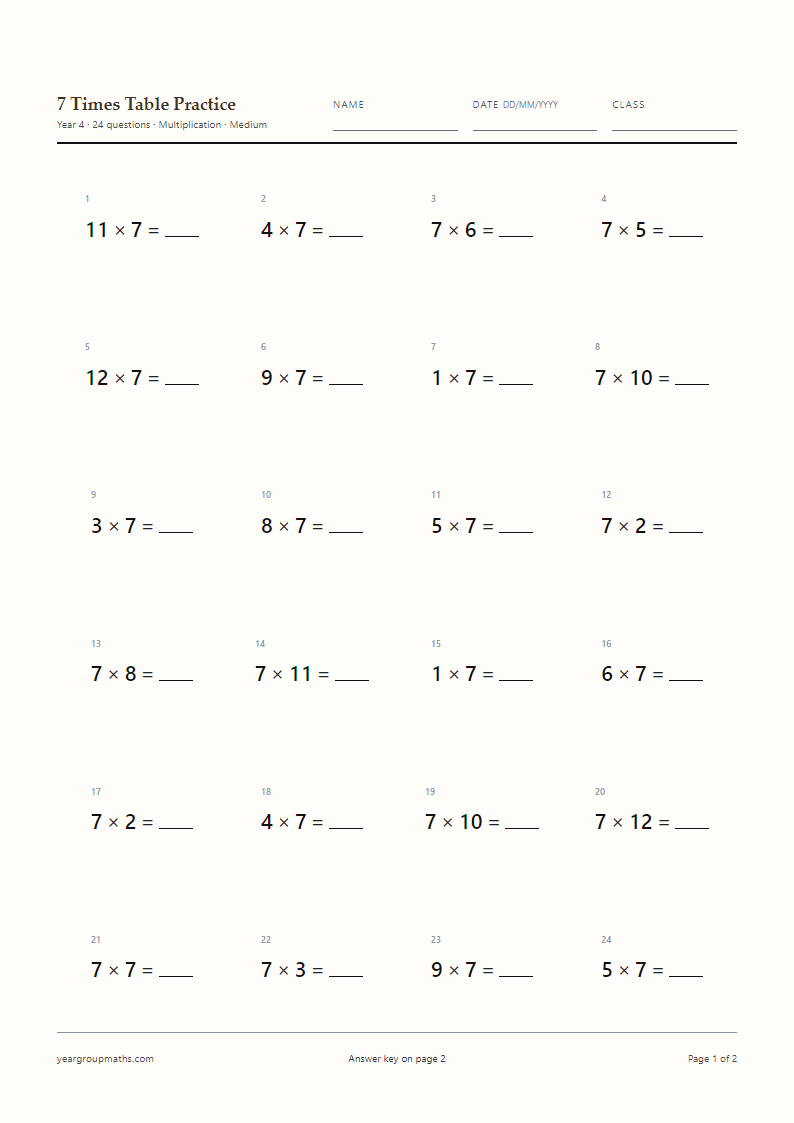
Twenty 3× facts, arranged in four columns and five rows, are set in 18 pt type for the Year 2 preset with the answer key on its own page. The questions appear in a shuffled order rather than counting up 3, 6, 9, 12, so children have to retrieve each fact instead of reciting a chant.
The topic is already selected, so the only decision is how hard you want the multipliers to be. Medium samples from 2 to 10, Hard runs to 12, and Easy keeps to 1–5 with more repetition for children who are still securing the pattern.
The digit pattern worth pointing out
In the 3× table the digits of every product add up to 3, 6 or 9: 3, 6, 9, 12 (1 + 2 = 3), 15 (1 + 5 = 6), 18 (1 + 8 = 9), and so on up to 36 (3 + 6 = 9). Children who spot this get a self-check that costs nothing and works on every row of the sheet.
The pattern is a check, not a method. It tells a child that 3 × 7 cannot be 22, because 2 + 2 is not a multiple of three. Pairing it with skip counting in threes gives both a way to work the fact out and a way to confirm it afterwards.
Where the 3× table usually sits
The 3× table tends to arrive after 2, 5 and 10 because there is no simple doubling or place-value shortcut. That makes repetition matter more here than in the earlier tables. A twenty-question sheet with a mix of orders, missing numbers and the matching division facts is a better weekly routine than one long test.
If a child can do 3 × 6 but not 6 × 3, switch the sheet to Missing number and let them see the fact from both directions. The commutativity is obvious on paper in a way it is not when someone is firing facts at them verbally.
How to use it
How to use this generator
- Year is preset to 2; move it up or down to change the type size and multiplier range.
- Confirm that Tables to practise shows 3× ticked and the others clear.
- Pick Multiplication, Division or Missing number to change what the blank looks like.
- Generate, then print both pages or page 1 alone.
FAQ
Frequently asked questions
How many questions should a 3× sheet have?
Twenty is enough for a starter or a homework task. Twenty-four fills a lesson slot, and thirty is a useful end-of-week check. Choose 40 or 60 only when you want a longer assessment; those print over two sheets.
Can I mix the 3× table with others?
Yes. Tick 3× plus any other tables, or choose Mixed for a random spread of 1–12. Mixing is harder, so keep single-table sheets for the week a table is introduced and move to mixed practice once it is secure.
Why do the products add up to 9, 6 or 3?
Every multiple of three has a digit sum that is also a multiple of three. It is a quick way for a child to check an answer, though it does not replace knowing the fact.
Does the answer page show the same order?
Yes. The answer page uses the same grid, the same type size and the same question order, so you can read across from page 1 to page 2 without hunting.
Can I print this in greyscale?
The whole sheet is designed for black-and-white printing. The answer colour is a deep red that stays legible when a mono printer converts it to grey, and no question depends on colour.
Is there a version with remainders?
Division in the 3× table is exact by default, so 15 ÷ 3 = 5. If you want remainders, use the short division or bus stop pages, where Dividend ÷ Divisor questions can include them.
More worksheets