Worksheet guide
What is on the 6 times table worksheet
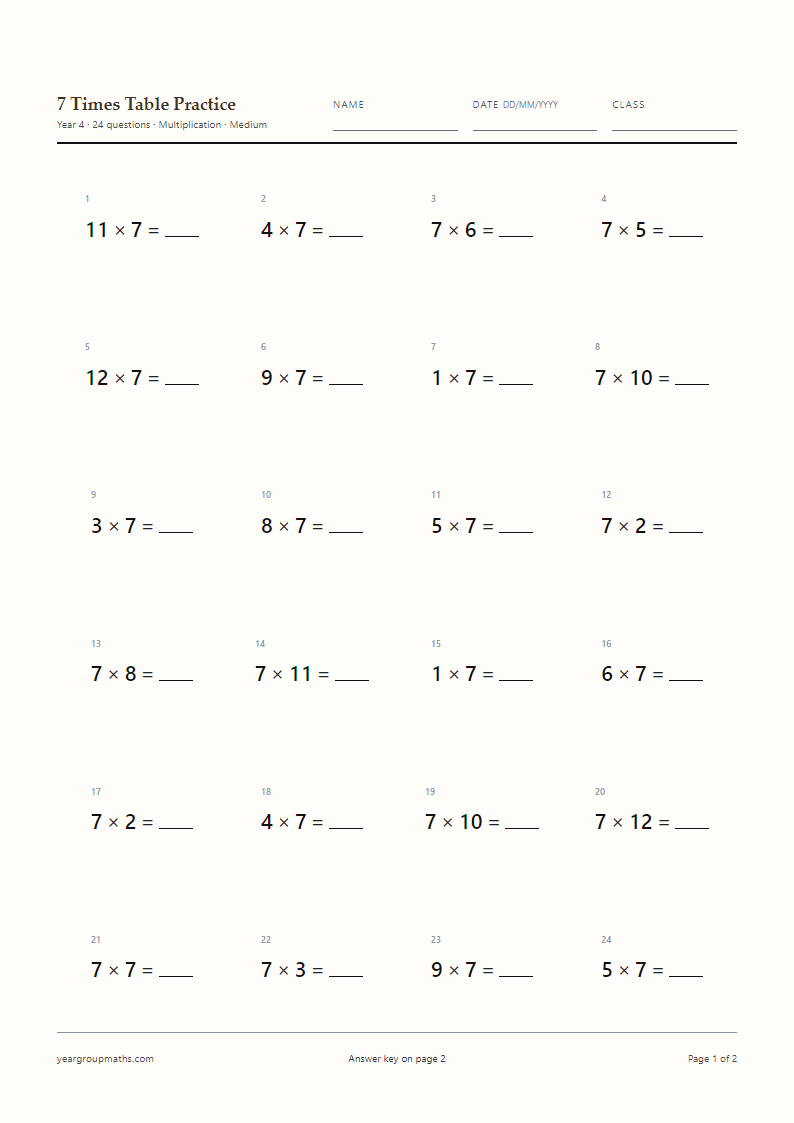
The page opens with 6× selected and twenty multiplication facts in a four-by-five grid. Type size is 18 pt on the Year 2 preset, the header leaves space for a name, date and class, and the answer key is on page 2 in the same order.
Twenty questions is deliberate for a table like this. Six is the point where facts stop being patterns and start needing retrieval practice, and a short sheet done three times a week beats a long one done once.
Six is five and one more
Every 6× fact can be built from the 5× table plus one more group: 6 × 7 is 5 × 7 plus 7, so 35 + 7 = 42. Children who know their 5s therefore have a route into the 6s that does not rely on memory. It is also the reason the 6× products sit one step above the 5× products in the same row.
The same reasoning works in reverse: 6 × 8 is double 3 × 8, because six is two threes. Two different decompositions, one answer. Asking a child to explain which one they used is a much better use of the sheet than asking them to copy it out.
Common errors to watch for
The most common 6× error is a 5× answer, because the child has defaulted to the table they know better. The second is an off-by-six slip, usually when a fact is half-remembered. Both are easy to see from the answer page: look for answers that are one multiple out.
The missing-number version is a good check on understanding. A child who can do 6 × 7 = 42 may still be stuck on 42 = 6 × _. Switching Question type to Missing number produces exactly that test, with the same facts and the same marking page. Keep the sheet short enough to finish in one sitting; a page that runs over break is a page that teaches avoidance.
How to use it
How to use this generator
- Confirm that 6× is ticked and the other tables are clear.
- Use Easy for multipliers up to 5, Medium for 2–10, Hard for 2–12.
- Try Question type Missing number for a comprehension check.
- Generate, then print page 1, page 2, or both.
FAQ
Frequently asked questions
What is the best order to learn the 6× table?
Most children do best by starting with 6 × 1, 2, 5 and 10, then building 6 × 6, 7 and 8 from the 5× table. Choose Easy for the first sheet and Medium once those are secure.
Why is 6 × 8 the same as 3 × 16?
Because six is two threes, so 6 × 8 is 3 × 8 twice, which is 3 × 16. It is the same doubling relationship that links the 2×, 4× and 8× tables.
Can I mix 6× with 7× and 8×?
Yes. Tick 6×, 7× and 8× together, then choose Mixed for a random spread or All for even coverage across just those three tables.
Does the sheet include the 11× and 12× facts?
Only on the Hard setting, which samples multipliers from 2 to 12. Medium stops at 10, Easy at 5.
Can I print a different set with the same settings?
Yes. Press Generate again and the questions change. Nothing is stored, so you can print a fresh set as often as you like.
Is there a 6× version for Year 4?
Change the Year dropdown to 4. The type size drops to 16 pt and the default question count rises to 24, which suits older classes.
More worksheets