Worksheet guide
What is on the 7 times table worksheet
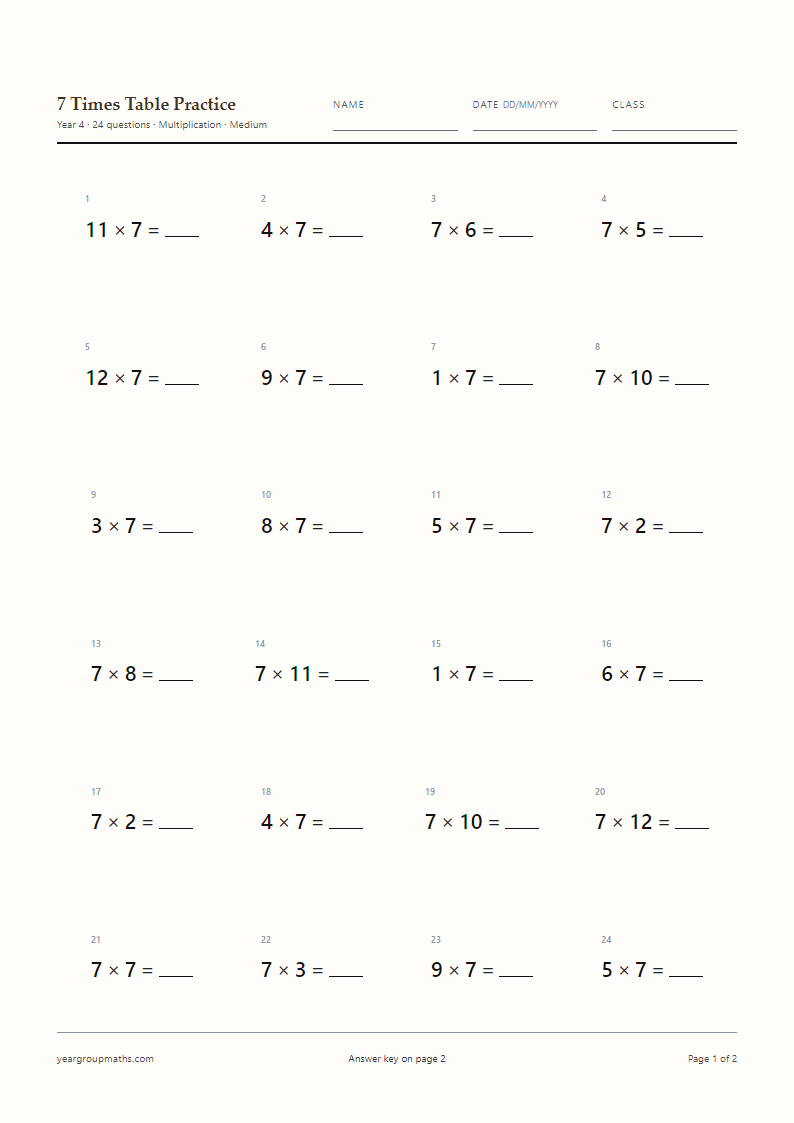
Twenty 7× facts in shuffled order, at 18 pt on A4, with 7× preselected and the answer key on page 2. Because the facts are not in sequence, a child cannot fall back on chanting 7, 14, 21, 28 and hope the right one appears.
The default difficulty is Medium, which samples multipliers from 2 to 10. Hard adds 11 and 12, and Easy limits the multipliers to 1–5 so a child can build confidence on the smaller facts first.
Building 7× from facts you already know
Seven is five plus two, so 7 × 8 is 5 × 8 plus 2 × 8: 40 + 16 = 56. It is also ten minus three, so 7 × 8 = 80 − 24 = 56. Both routes are legitimate and both depend on tables the child already has. Teaching one route and then the other gives a child a fallback when memory fails.
The 7× table also has fewer obvious patterns than 2, 5 or 10, which is exactly why it is worth the practice. A child who can derive 7× facts from 5× and 2× is not stuck when they forget one; a child who has only memorised them is.
Using the answer page diagnostically
After marking, sort the wrong answers into two piles: facts the child does not know at all, and facts they know but misremember under time pressure. The first pile needs teaching; the second needs a short daily sheet like this one. The answer page makes the sort quick because the questions and answers line up.
If the errors cluster around 7 × 6, 7 × 7 and 7 × 8, that is normal — those are the facts with no easy anchor. Give the child the 5× + 2× route for those three specifically rather than re-teaching the whole table. That keeps the practice focused and the marking honest.
How to use it
How to use this generator
- Leave 7× ticked on its own, or add 6× and 8× for a harder mixed sheet.
- Start on Easy if the table is new; move to Medium once 7 × 2 to 7 × 5 are secure.
- Choose 20 questions for a starter and 30 for a weekly check.
- Print both pages, or page 1 only if the sheet is going home.
FAQ
Frequently asked questions
Why is the 7× table considered the hardest?
It has fewer visual patterns than 2, 5, 10 or 11, and the products do not share an obvious digit rule. That makes it more dependent on retrieval practice than the other tables.
What is a good trick for 7×?
Use a table you already know. 7 × 8 = 5 × 8 + 2 × 8 = 40 + 16 = 56, or 7 × 8 = 10 × 8 − 3 × 8 = 80 − 24. Both are quick once the 5×, 2× and 10× tables are secure.
Should I teach 7× before or after 8×?
Schools differ. Many interleave the 6×, 7× and 8× tables so children have to choose between them, which is closer to how the facts are used in the multiplication tables check.
Can I get a sheet with only the harder 7× facts?
Not as a single option. The closest is to print a Hard sheet, which includes 7 × 11 and 7 × 12, and use the answer page to see which facts are still shaky.
Can I print two different 7× sheets for a pre-test and post-test?
Yes. Press Generate twice with the same settings and you get two different sets of twenty questions, both with their own answer page.
Does the sheet use the multiplication sign or the letter x?
It uses the multiplication sign (×), with tabular figures so the digits line up in columns.
More worksheets