Worksheet guide
What is on the 9 times table worksheet
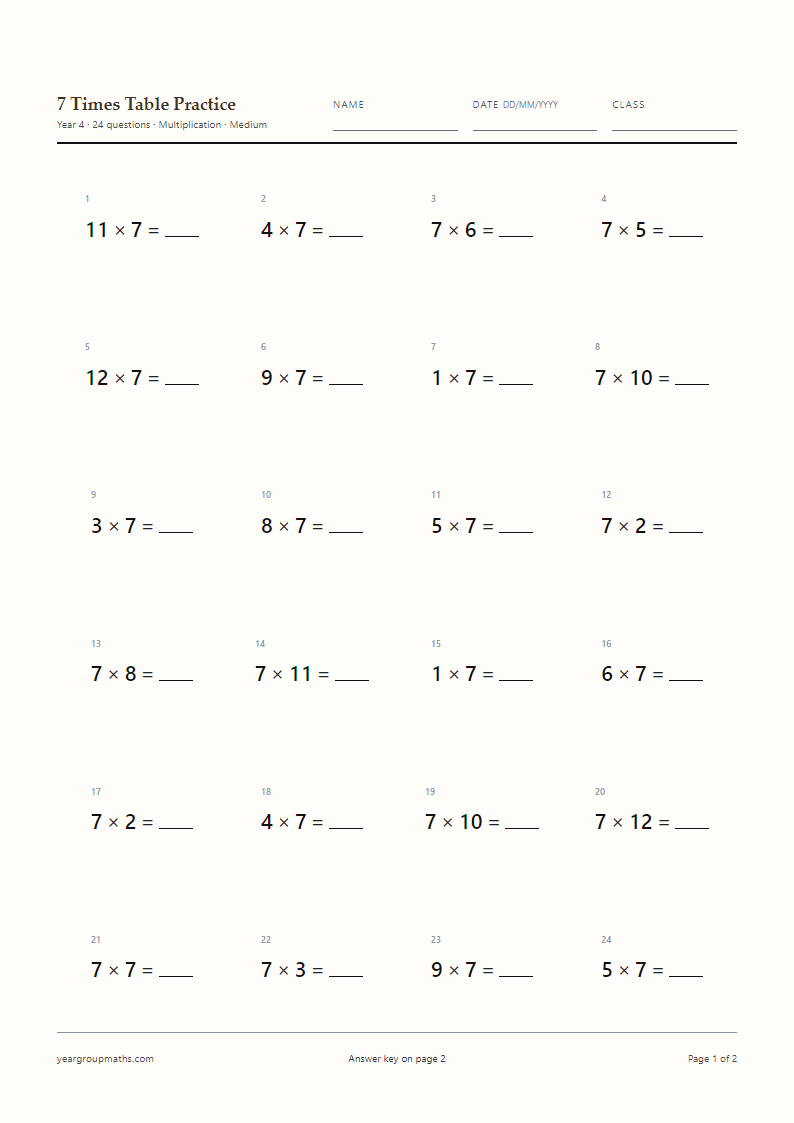
Twenty 9× facts in random order, 18 pt, one A4 page, with 9× already selected and the answer key on page 2. The random order matters here: a child who has learned 9, 18, 27, 36 as a chant can still be lost when 9 × 7 appears on its own.
The sheet can also be switched to Division or Missing number without changing anything else, which is useful for checking whether a child knows the fact or only knows the chant.
The digit-sum pattern
The digits of every product in the 9× table add up to nine: 9, 18 (1 + 8), 27 (2 + 7), 36, 45, 54, 63, 72, 81, 90, 99 (9 + 9 = 18, then 1 + 8 = 9), 108 (1 + 0 + 8 = 9). Children can use it to check an answer instantly, and it is one of the few genuine shortcuts in the tables.
The other route is ten times minus one times: 9 × 7 = 70 − 7 = 63. Both methods rely on facts the child already has, and both are worth teaching so that a forgotten answer has two ways back.
What the pattern cannot do
The digit sum tells you whether an answer could be a multiple of nine; it does not tell you which one. A child who writes 9 × 7 = 36 has a valid digit sum and a wrong answer. That is why the sheet is a retrieval exercise rather than a pattern exercise, and why the answer page is worth using properly.
Use the pattern as a check after the fact, not as a method for generating it. If a child is using digit sums to work out every answer, they are doing extra work for the same result and will be slower than a child who simply knows 9 × 7. A two-minute timed sheet once a week is enough to keep the facts warm, and the answer page makes the marking quick.
How to use it
How to use this generator
- Leave 9× as the only table ticked for a focused sheet.
- Choose Hard to include 9 × 11 and 9 × 12.
- Switch to Missing number for a quick understanding check.
- Generate and print; answers are on page 2.
FAQ
Frequently asked questions
What is the 9× finger trick?
Hold up ten fingers, bend down the finger for the multiplier, and read the tens from the fingers on the left and the ones from the fingers on the right. It works up to 9 × 10 and is a useful scaffold, not a replacement for recall.
Why do the digits of 9× answers add up to nine?
It is a property of multiples of nine in base ten. It is reliable for every whole-number multiple of nine, including large ones, as long as you keep adding the digits until you reach a single digit.
Should children learn 9× before 11× and 12×?
Most schemes put 9× before 11× and 12×, but the order varies. The generator lets you print any table on its own, so you can follow your school’s sequence.
Can I get a 9× sheet with 30 questions?
Yes, choose 30 in Questions per page. The layout switches to five columns and a smaller type size so the sheet still fits one A4 page.
Does the answer key show the working?
No, it shows the answers in the same positions as the questions. Showing working would give away the method and make the page harder to read at a glance.
Can I use this sheet for a timed test?
Yes, but decide the time before you start and keep it the same each week so the comparison is fair. Two minutes for twenty facts is a common starting point.
More worksheets